
When TikTok Becomes Your Doctor: Can Kenyans Tell Health Facts from Online Fiction?
Posted by Dorcas Ombuya
TikTok is increasingly becoming a go-to source of health information for Kenyans seeking answers about symptoms, fertility and other medical concerns. However, as more people turn to the platform for health advice, questions are emerging about the accuracy of the information shared, the credibility of content creators and whether users can distinguish medical facts from misinformation.
When
TikTok Becomes Your Doctor: Can Kenyans Tell Health Facts from Online Fiction?
By
Dorcas Ombuya
For many Kenyans, TikTok is no longer simply a platform for entertainment, dancing and comedy. It has become a place to search for answers about health.
A person experiencing unexplained symptoms can type a few words into the search bar and, within seconds, find videos promising explanations. Others turn to the platform for advice on fertility, menstrual health, infections, weight loss and remedies for common illnesses.
Some creators share useful information, while others promote treatments and health claims without providing reliable scientific evidence. The challenge is knowing which advice to trust and which could put one's health at risk.
As social media increasingly influences health decisions, an important question arises: are Kenyans equipped to distinguish credible medical information from online fiction?
Why TikTok health advice is so appealing
TikTok's popularity lies partly in its simplicity. Health information is presented in short videos, often using everyday language and personal experiences that viewers can easily relate to.
For someone struggling with a health concern, hearing another person describe similar symptoms can feel reassuring. A creator may appear confident, share a personal success story and recommend a remedy that seems affordable and easy to access.
However, a personal experience is not necessarily medical evidence. What worked for one individual may not work for another, and symptoms that appear similar may have completely different causes.
The
danger begins when viewers treat these videos as a substitute for proper
medical assessment.
When
online remedies become real-life experiments
Some
Kenyans are already making health decisions based on remedies and experiences
shared on TikTok.
“Belnem
“, (not her real name), said she had been battling recurring vaginal infections
and decided to look for help online.
“I
followed advice on the platform about taking
raw garlic to clear vaginal infections. I took it every morning and
evening, but later felt that the practice had interfered with the
family-planning method I had been using for five years because I ultimately
conceived despite being on contraceptives”
She attributed this to the use of the Garlic which she has initially thought could cure the frequent vaginal infections.
Her experience raises questions about how easily people can adopt remedies without understanding their possible effects or whether the advice is supported by medical evidence.
Kaz,(not
her real name ),gives her account as well.
“I learnt about using cloves to regulate menstruation through TikTok. I came across videos discussing their supposed benefits and decided to try them because I wanted to improve the regularity of my menstrual cycle. After trying the remedy, I noticed changes in my menstrual cycle and also experienced weight loss. These changes made me believe that the remedy was helping me. “She recounts
“What attracts people to such information is the way it is presented. Someone shares
a personal experience, explains what they used and talks about the results they
obtained. When you are experiencing a similar problem, you may feel encouraged
to try the same thing.”She explains
“However, people should understand that an experience shared on TikTok does not necessarily mean that the same remedy will work for everyone.” She adds
Another TikTok user, with the Pseudonym “Nelim” Who had previously been diagnosed with Polycystic Ovarian Syndrome (PCOS) ,recounts her experience
“I came across information about using guava leaves and Soursop as a remedy for infertility on TikTok and became interested in trying them. There were people sharing their experiences and explaining the benefits they associated with using the remedies .I decided to try it because I was looking for ways to improve my reproductive health. I believe the remedy helped me conceive, although I cannot scientifically establish that it was responsible.” She explains
“ I found myself relying on the experiences and recommendations of other users.The challenge is that you may watch someone explain how a particular remedy worked for them and assume that you will experience the same results. Yet reproductive health is different for every woman.” She adds .
These accounts illustrate how personal testimonies can influence health choices. However, they do not establish that the remedies caused the reported outcomes or that they are safe and effective for everyone.
Without
proper medical assessment, viewers may struggle to distinguish coincidence,
personal experience and scientifically established treatment.

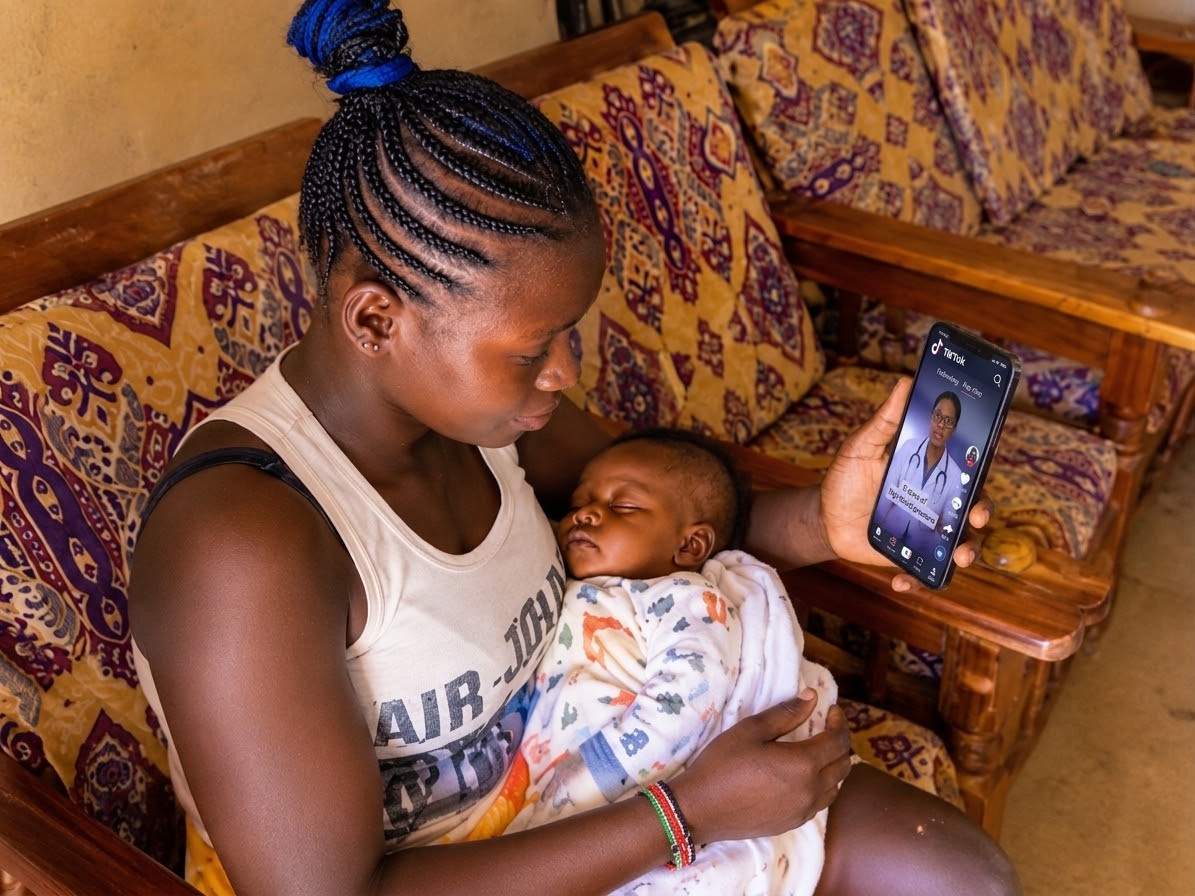
A Tiktok
user ,uses her phone to access health information
Credit:Getty
Images
The risks go beyond trying a home remedy
According to Boniface Malandi, a Tutorial Fellow and Research Scientist at Mount Kenya University,and SCIJOURN -Kenya ,applying unprofessional or scientifically unproven health information can have serious consequences.
He explains that,“People tend to compare their symptoms with videos they encounter online and conclude that they have a particular condition without undergoing the necessary clinical investigations.This can result in self-diagnosis, inappropriate self-medication and delays in seeking professional treatment.”
Malandi also points to sexual and reproductive health as an area of concern. Content discussing conditions such as polycystic ovary syndrome (PCOS), contraceptives, fertility and sexually transmitted infections can influence people to purchase over-the-counter medication or seek unnecessary treatment.
Recently,
there has been The cetirizine craze ,which has raised concerns amongst health
professionals.
Cetirizine,
a common antihistamine used to treat allergies, recently became the subject of
a viral social media trend in Kenya, following claims that it could tighten
women's vaginas during sexual intercourse.
The trend saw some social media users recommending swallowing multiple tablets or inserting them vaginally, sparking concern among healthcare professionals.
The trend prompted warnings from healthcare professionals, with Pharmaceutical Society of Kenya President Dr Wairimu Njuki dismissing the belief that vaginal dryness translates into tightening. “Reduced lubrication does not strengthen vaginal muscles or alter vaginal anatomy,” she cautioned. Pharmacy and Poisons Board Director of Pharmacy Practice Dr Wilfred Ochieng also warned that viral popularity should not be mistaken for medical evidence, noting that “trending or getting viral does not substitute scientific evidence.”
The
concern is not that people are becoming interested in their health. Rather, it
is that some may act on information that has not been properly verified.
When TikTok starts competing with the Real doctor
The influence of online health content can extend beyond the decision to try a home remedy.
Malandi observes that some people begin questioning prescribed medication or disregarding medical advice because it contradicts something they have watched online.
This can undermine the relationship between patients and healthcare professionals. A patient may stop taking prescribed medication, change a treatment routine or delay follow-up appointments based on a creator's claims.
He further notes that social media is widely used by both adults and children, making it difficult for parents to control all the health-related content that appears on their children's feeds.
Repeated exposure to certain claims can gradually shape how people understand symptoms, illnesses and treatment options.
Not everything on TikTok is misinformation
Despite the risks, social media should not be dismissed as an entirely unreliable source of health information.
Qualified healthcare professionals and recognized health institutions also use digital platforms to educate the public, explain medical conditions and correct misconceptions.
In September 2024, the World Health Organization announced a collaboration with TikTok aimed at promoting reliable, science-based health information and addressing misinformation on the platform.
On
29th January 2025, the Kenya Medical Practitioners and Dentists
Council raised concerns about
individuals presenting themselves as medical professionals and sharing
questionable health advice. The Council cautioned that such
advice, particularly when based on unverified or outdated information, could
expose unsuspecting Kenyans to misdiagnosis, delayed treatment and worsening
health conditions.
The
Council also reminded the public that using the title Doctor without the
required registration or recognised qualifications is an offence under the
Medical Practitioners and Dentists Act (CAP 253). It urged Kenyans to verify
the credentials of medical practitioners through its official register or SMS
service.
The
distinction, therefore, is not simply between information found online and
information found offline. It is about the credibility of the person sharing
it, the evidence behind the claims and whether the information is presented
responsibly.
Digital
Healthcare Needs Professional Oversight
However,
the growing influence of digital platforms in healthcare does not mean that
technology itself is the problem. When properly regulated and used by qualified
professionals, digital tools can improve access to medical information,
medication guidance and patient care.
Speaking
during a Pharmaceutical Society of Kenya webinar on telepharmacy and remote
patient care in the digital era, digital health professional and pharmacist at
NILA Pharmaceuticals ,Dr Gertrude Mungai emphasised the importance of patient
safety, professional accountability and ethical standards in digital
healthcare.
She
highlighted concerns surrounding patient privacy, confidentiality, data
protection and cybersecurity, noting that digital healthcare must operate
within appropriate regulatory frameworks.
Dr
Mungai also addressed the need for licensing and validation of digital health
platforms, emphasising that online healthcare services should have clearly
defined professional roles and responsibilities.
Her
presentation further examined the limitations of artificial intelligence tools
such as ChatGPT, Gemini and Claude, cautioning healthcare professionals against
blindly relying on AI-generated information without critically evaluating its
accuracy.
She
argued that despite technological advancements, professional clinical judgment
and human interaction remain essential in healthcare delivery.
"The
goal is not less human pharmacy practice; it's more meaningful patient
care," she said.
Dr
Mungai further stressed that pharmacists must strengthen their clinical
expertise, digital literacy, communication skills and ethical reasoning to
remain effective in an increasingly technology-driven healthcare environment.
Her
argument reinforces an important distinction in the debate surrounding TikTok
health advice: digital platforms can support healthcare delivery, but access to
health information should not be confused with access to qualified medical
assessment.
As
she put it, "AI is not here to replace you,you are still very much
needed."
Who is behind the health advice?
Malandi advises social media users to examine the qualifications and credibility of anyone offering medical guidance.
“Viewers should establish whether the person sharing the information is a qualified and licensed healthcare professional, whether they are actively practising and whether the advice is consistent with recognised medical guidance.”He adds
He also recommends cross-checking health information with established institutions such as the Kenya Pharmacy and Poisons Board, the World Health Organization, Africa CDC and Kenya's Ministry of Health.
A creator's confidence, number of followers or popularity should not be mistaken for medical expertise.
The
problem with sharing before checking
Misinformation does not spread through content creators alone. Ordinary users also contribute when they forward videos without checking whether the information is accurate.
A health video shared in a WhatsApp group or reposted on Facebook can quickly reach people who may be dealing with the very condition being discussed.
Malandi encourages users to avoid circulating unverified health content. He also supports responsible efforts to challenge or report creators who consistently share misleading information.
However,
correcting misinformation requires more than telling people not to trust
TikTok. It requires giving them the skills to evaluate what they see.
He
emphasises the importance of digital health literacy, noting that awareness
should extend beyond medical schools to young people and the wider public.
What
should Kenyan viewers do before trying online health advice?
Before
acting on health information found on TikTok, viewers should take a few
precautions:
1.
Check the creator's qualifications. Establish whether the person is a
recognised and licensed healthcare professional.
2.
Look for reliable sources. Medical claims should be supported by
credible research or recognised health institutions.
3.
Be cautious of miracle claims. Promises of instant cures, guaranteed
fertility or treatments that supposedly work for everyone should raise
questions.
4.
Consider commercial interests. Find out whether the creator is promoting
a product, supplement or service for financial gain.
5.
Avoid self-medication. Do not start, stop or change prescribed
medication based solely on a social media video.
6.
Seek professional advice. Persistent symptoms, unusual changes in the
body and concerns about medication should be discussed with a qualified
healthcare professional.
7.
Think before sharing. Avoid forwarding health information whose accuracy
has not been established.
Then
where does the Solution Lie?
TikTok has made health information more accessible, but accessibility does not automatically translate into accuracy.
For many Kenyans, the platform may be the first place they turn when faced with a health concern. That makes the responsibility of creators, healthcare professionals, regulators and users even greater.
The
solution is not necessarily to stop seeking health information online. It is to
become more critical of what is presented as medical truth.
As Malandi's observations suggest, digital health literacy needs to become part of everyday public awareness. People should be empowered to ask questions, verify claims and recognise when an online video cannot replace a professional consultation.
Ultimately,
a video may offer an explanation, a personal story or a possible remedy. But
when it comes to making decisions about one's health, a TikTok recommendation
should never take the place of sound medical advice.